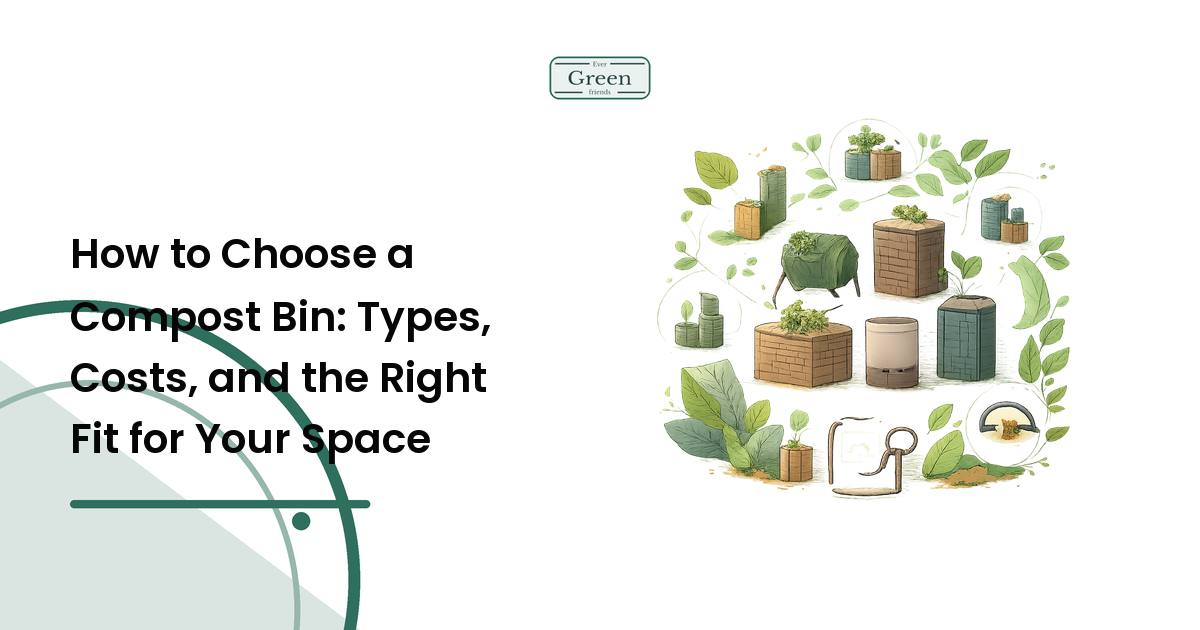
Standing in front of a wall of compost bins — or a browser tab full of them — is oddly stressful for something whose whole job is to sit still and rot. Tumbler or plastic bin? Wormery or bokashi bucket? Spend a little, or a lot?
The key takeaway up front: the best compost bin is the one that matches your space, the waste you produce, and how much effort you want to give it — not the most expensive or the most complicated. For most households a basic enclosed bin, or even a free DIY one, does the job. You only pay more when a specific constraint — no garden, a wish for speed, or lots of cooked-food waste — makes it worth it. Here's how to choose a compost bin, with an honest look at every common type.
First, Match the Bin to How You Live
Before comparing products, get clear on four things — they decide almost everything, and budget follows:
- Space. A roomy garden, a small yard or balcony, or no outdoor space at all.
- What you'll compost. Mostly garden waste, mostly raw kitchen scraps, or a lot of cooked food, meat, and dairy.
- Effort. Happy to turn a heap now and then, or you want something you feed and forget.
- Speed. Content to wait months for free soil, or you want compost quickly.
Nail these four and the right bin usually picks itself. Buy the trendy tumbler first and it may be the wrong tool for your waste.
The Main Types of Compost Bin, Compared
Here is each common option and its honest trade-offs, cheapest first — so you can stop as soon as one fits. The cheapest thing that genuinely works is usually the best place to start.
Open and DIY bins (pallet, wire, or a simple heap)
The cheapest route, often free — four pallets wired into a square, or a ring of chicken wire. It suits gardens with space and plenty of garden waste. Trade-offs: it takes room, looks rustic, breaks down slowly out in the weather, and barely deters rodents. It ranks first anyway because nothing beats free, and it swallows big volumes of leaves and prunings a small bin can't.
Enclosed plastic bins (the classic cone or "Dalek")
The default all-rounder. Inexpensive — many councils subsidise them — tidy, and it holds in warmth and moisture, which speeds things up. Sitting open-bottomed on soil, it lets worms move in from below. The catch: it's awkward to turn, and you harvest through a small hatch at the base. For most people with a garden this is the best compost bin for beginners — cheap, forgiving, low-effort.
Tumblers (rotating drums)
A raised drum you spin to mix the contents. In the compost tumbler vs bin question, the tumbler wins on aeration and tidiness: you turn it with a handle instead of a fork, it breaks down faster, and it's raised so rodents can't get in. Trade-offs: it costs more, holds less, and gets stiff to turn when full. Worth it if the effort of turning a heap is what's stopping you.
Wormeries (vermicomposting)
Stacked trays of composting worms that eat your kitchen scraps. This is the go-to compost bin for small spaces: compact enough for a balcony or even indoors, and it produces rich castings plus a liquid plant feed. Trade-offs: a middling cost and some care — keep it out of frost and fierce heat, don't overfeed, and go easy on citrus, onion, and meat. Ideal when you have no garden but still want to use your scraps.
Bokashi bins (fermentation)
An indoor bucket and bran that ferments — essentially pickles — your scraps. Its strength is taking what other systems can't: cooked food, meat, dairy, even small bones. It's affordable, fills fast, and stays odour-free when managed well. The catch: it doesn't make finished compost alone — the output must be buried or added to an outdoor bin to break down, and you keep buying bran.
Hot composters (insulated bins)
Thick, insulated bins that trap the heat composting generates. They're the fastest — often producing compost in weeks rather than the many months an open heap takes — they keep working through winter when ordinary bins stall, and they handle more food waste. The trade-off is price: these are by far the most expensive, worth it only for large volumes, real need for speed, or a climate that leaves a standard bin dormant half the year.
No outdoor space at all?
You don't have to own a bin at all. Many areas offer kerbside food-waste collection, community gardens with shared heaps, or drop-off schemes you feed with a countertop caddy. Sometimes the greenest, lowest-waste choice is sharing a bin rather than buying one.
Compost Bin Types at a Glance
Compare the main types of compost bins quickly. Cost is relative, not exact, since prices vary by region and supplier.
| Bin type | Space needed | Relative cost | Speed | Effort | Best for |
|---|---|---|---|---|---|
| Open / DIY bin | Large | Free–low | Slow | Low–medium | Big gardens, lots of leaves and prunings |
| Enclosed plastic bin | Small–medium | Low | Medium | Low | Most gardens; beginners |
| Tumbler | Small | Medium | Faster | Low (easy turning) | Tidy spaces; people who hate forking a heap |
| Wormery | Very small | Medium | Medium | Medium | Balconies, flats, no garden |
| Bokashi | Minimal (indoor) | Low–medium | Fast to fill | Low | Cooked food, meat, dairy; flats |
| Hot composter | Small–medium | High | Fastest | Low | High volume, speed, cold climates |
A Simple Way to Choose
Prefer a shortcut? Stop at the first line that describes you:
- No outdoor space? A wormery or bokashi bin, or a kerbside or community scheme.
- Small yard or balcony, mostly kitchen scraps? A wormery, or a small tumbler or enclosed bin.
- Average garden, mixed waste, want it cheap and simple? A standard enclosed plastic bin — the default best pick.
- Lots of garden waste and room to spare? An open or DIY bin, or a large enclosed one.
- Hate turning, or want it neat and a bit faster? A tumbler.
- Big volumes, or year-round composting in a cold climate? A hot composter.
- Lots of cooked food, meat, or dairy? A bokashi bin as a front-end, paired with any outdoor system.
Mistakes to Avoid When Buying a Compost Bin
A few missteps turn a good bin into a frustrating one:
- Buying too small. A bin that's always full stops you composting; if unsure, size up, as a fuller bin also holds heat and works faster.
- Buying for the waste you wish you had. Match the bin to what your household really throws out, not an imagined future of neat garden trimmings.
- Overspending before it's a habit. Start cheap and upgrade later once composting has stuck — pay more only to solve a real limit like turning effort, no garden, or speed. A pricey bin gathering cobwebs is the least sustainable option of all.
- Assuming pricier means better compost. The microbes don't care what the container costs; air and a rough two-to-one balance of dry "browns" to wet "greens" matter far more, and most bin problems are a ratio issue — see our guide to why compost bins smell and stall.
Frequently Asked Questions
What is the best compost bin for beginners?
For most beginners with a garden, a standard enclosed plastic bin: inexpensive (often council-subsidised), tidy, forgiving, and near maintenance-free. It makes compost with the least fuss and outlay, so you learn whether the habit sticks before spending more.
Compost tumbler vs bin — which is better?
Neither is universally better; it depends on your priority. A tumbler aerates with a spin, breaks down waste faster, and keeps rodents out, but costs more and holds less. A plain bin is cheaper and higher-capacity but slower and harder to turn. Choose by your main barrier: effort and tidiness, or cost and capacity.
What compost bin is best for small spaces or no garden?
A wormery is strongest for balconies, flats, and small yards — compact, able to work indoors, and it turns scraps into castings and a liquid feed. A bokashi bin pairs well since it handles cooked food and fits under a counter. With no space at all, a kerbside or community scheme needs no bin.
How big should a compost bin be?
Match it to how much you'll add, and size up if unsure — an under-sized bin fills and stalls, while a larger one holds heat and works faster. Garden-heavy households need more capacity than kitchen-only ones.
Do I need to spend a lot to start composting?
No. A free DIY pallet or wire bin, or a modest enclosed bin, composts as well as an expensive one, because the process depends on air and the browns-to-greens balance, not the container. Start cheap, and upgrade only if a real limit like speed or space justifies it.
Which compost bin handles cooked food, meat, and dairy?
A bokashi bin is the one built for those. It ferments the waste in a sealed bucket rather than composting it in the open, avoiding the smell and pests cooked food causes in a normal bin. The output then needs burying or adding to an outdoor bin to finish.
Start Composting, Whatever Your Space
Choosing a compost bin comes down to four honest questions — space, waste, effort, and speed — and for most people the answer is a simple, inexpensive bin, not the priciest on the shelf. Pick the smallest, cheapest option that fits your life, size it a little generously, and you'll be turning scraps into free soil before long. For plain-language composting help, honest low-cost green swaps, and a friendly place to ask which bin suits you, join the Evergreen Friends community at https://evergreen-friends.com.