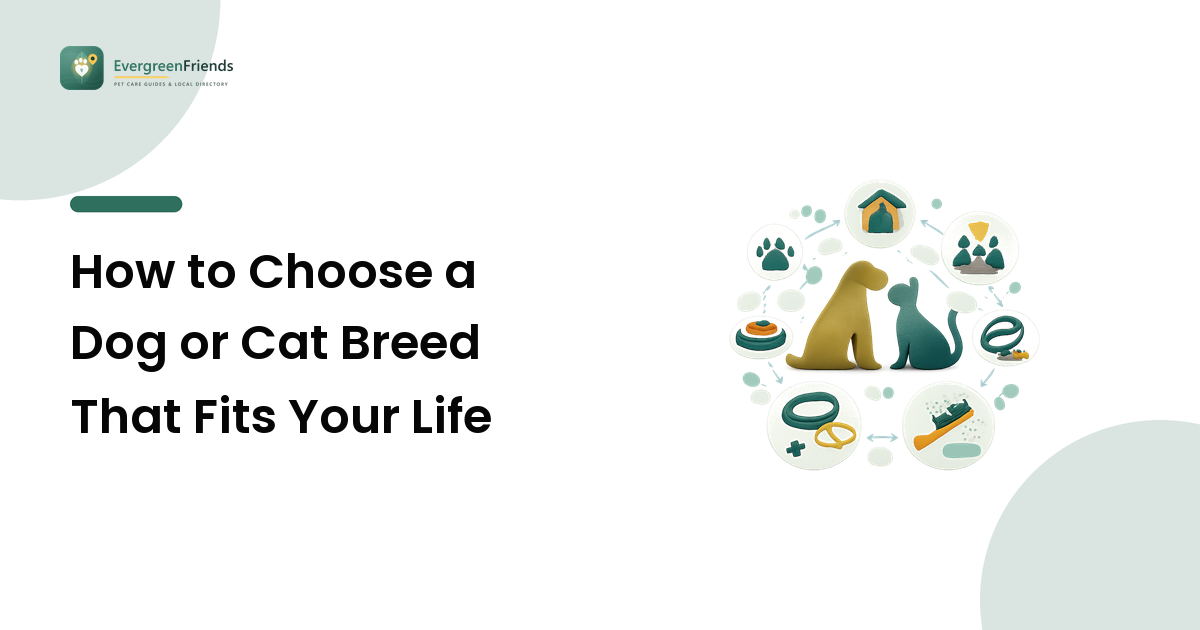
Choosing a breed by looks is how most pet regrets start. The Husky in the photos is stunning; the Husky in a ninth-floor apartment with a family that works long hours is miserable — and so is the family. The good news: you don't need to be an expert to get this right. You need an honest picture of your own life, and a way to match it against what each breed typically needs.
That's what this guide gives you. Work through the five questions below, and you'll turn "I like the fluffy one" into a shortlist of two or three breeds you can research properly. One promise before we start: everything here describes what's typical for a breed — tendencies, not guarantees. Every individual dog and cat is its own animal, and a rescue mix can be the best companion you'll ever have.
Start with your life, not the breed list
Before you look at a single breed profile, answer these honestly — write them down, because "roughly" is where wishful thinking sneaks in:
- Hours away from home. How many hours, on a normal weekday, will the pet be alone?
- Real activity level. Not the hiking you'd like to do — the walking you actually did last month.
- Space. Apartment or house? Stairs or lift? A garden, a balcony, or neither?
- Who lives with you. Toddlers, older kids, elderly relatives, other pets, allergy-prone family members?
- Budget and time for upkeep. Food, insurance, and vet care are ongoing; some coats also need weekly hours or regular professional grooming.
Notice that none of these questions is about the pet. That's deliberate. A breed choice fails when the life and the animal don't match — and you can only change one of those two things.
Dog or cat? Be honest about the daily commitment
If you're still deciding between species, the practical difference is daily, non-negotiable time.
Most dogs need to be taken out several times a day, rain or shine, and the majority of behaviour problems owners struggle with trace back to too little exercise and company. A dog suits a household where someone is reliably home for part of the day, or where doggy daycare or a walker fits the budget.
Cats are typically more independent — litter box instead of walks, and many are content alone during a workday — but "independent" doesn't mean "no needs." Cats still need daily play, company, scratching outlets, and a clean litter box, and some breeds are famously people-focused and vocal about it. If you want a pet that greets you at the door and joins every family activity, some cats will do exactly that — and some dogs won't.
There's no wrong answer here, only a wrong match. If your weekday can't absorb 60–90 minutes of walking and attention, that points toward a cat or a genuinely low-energy dog breed — and it's kinder to admit that now than after adoption.
The five matching factors, one by one
1. Energy level — the number one mismatch
Every breed profile you'll read describes an energy level, and it's the single most important line on the page. Working and herding breeds — think Border Collies, Belgian Malinois, and most Huskies — were typically bred to be busy all day. Without a job or serious daily exercise, that energy usually goes somewhere you won't like: chewed sofas, barking, digging, pacing.
Match ruthlessly:
| Your real activity | Dog energy fit (typical) | Cat energy fit (typical) |
|---|---|---|
| Short daily walks, quiet evenings | Companion/toy breeds, many mature rescues | Laid-back breeds like Ragdolls or British Shorthairs |
| A solid hour of activity most days | Most retrievers, spaniels, medium mixes | Most moderate-energy house cats |
| Running, hiking, dog sports weekly | Herding and working breeds | Active, playful breeds like Abyssinians or Bengals |
The rule of thumb: choose the energy level you can meet on your worst week, not your best one.
2. Space — smaller than you think, and bigger
Apartment living rules out fewer breeds than people assume — what matters more is energy and noisiness. A large, calm Greyhound is typically a better apartment dog than a small, vocal terrier with endless stamina. For flats, weigh three things: how much the breed tends to bark, how it handles being alone, and whether stairs or lifts will be workable when the pet is old or unwell.
For cats, indoor space is about vertical territory and things to do, not square metres. A climbing tree, window perches, and scratching posts turn a small flat into good cat territory. High-energy cat breeds in an unenriched flat, though, will invent their own entertainment — usually at 3 a.m.
3. Grooming load — hours you'll spend every week, forever
Coat care is the most underestimated cost in pet ownership, in both time and money. Long or double coats typically need brushing several times a week — daily during seasonal shedding — and breeds like Poodles and many doodle mixes usually need professional grooming every few weeks, which adds up to a real annual expense. Short-coated breeds still shed (often more than people expect), but a weekly brush usually covers it.
Two honest notes while we're here. First, shedding is managed, not cured — no routine makes a double-coated dog shed-free. Second, no breed is truly hypoallergenic. Some low-shedding breeds tend to bother allergy-prone people less, but reactions vary from person to person and animal to animal. If allergies are a concern in your home, spend time with the specific breed — ideally the specific animal — before committing, and talk to your doctor about your options.
4. Kids, other pets, and the rest of the household
Family fit is about tendencies plus supervision. Breeds with reputations as family dogs — Labradors and Golden Retrievers are the classic examples — typically tolerate noise and chaos well, but any dog needs supervision around toddlers, and any dog can be overwhelmed. Very small breeds are often a poor match for small children — not because the dog is a danger to the child, but because the child is a danger to a two-kilogram dog.
For cats, look for breeds described as sociable and adaptable if you have kids or a dog at home, and plan a slow, separate-rooms introduction regardless of breed. If someone in the house is frail or unsteady on their feet, a large bouncy adolescent dog is a genuine hazard underfoot — a calmer, smaller, or older animal is the kinder choice for everyone.
5. Time horizon — puppies, adults, and life stages
A breed choice is a 10-to-20-year decision, so think in life stages. Puppies and kittens are wonderful and exhausting — house-training, socialisation, chewing, and midnight wake-ups are a months-long project (we've laid out exactly what that looks like in bringing home a new puppy or kitten). An adult rescue skips much of that and shows you the personality you're actually getting. Larger dog breeds typically have shorter lifespans than small ones, and giant breeds often have higher joint- and health-care needs as they age — ask your vet what the breeds on your shortlist commonly face, and factor insurance quotes into the decision while you're at it.
Purebred, mix, or rescue?
A quick reframe: breed profiles are a prediction tool, not a purity contest. A purebred from a responsible source gives you the most predictable size, coat, and temperament tendencies. A known mix (say, Lab × Poodle) gives you a blend of two sets of tendencies. A rescue of uncertain ancestry gives you less prediction — but an adult rescue compensates by showing you its actual, formed personality, which in many ways beats any prediction. Shelter staff and fosterers know their animals; tell them the honest answers you wrote down in step one and let them match you.
We don't endorse specific breeders or marketplaces — that's a deliberate policy. Wherever you source your pet, take your time, see where the animal was raised, and walk away from anyone who pressures you.
Build your shortlist
You now have everything you need:
- Write down your five honest answers (hours alone, activity, space, household, budget).
- Eliminate whole categories that clash — high-energy working breeds if you're sedentary, heavy-grooming coats if you have neither time nor grooming budget.
- Pick two or three candidate breeds and read their full profiles — temperament, exercise needs, grooming load, typical health considerations, and how they tend to do with kids and other pets.
- Meet the breed in person where you can: breed meetups, shelters, friends' pets. Ten minutes with a real animal beats ten hours of reading.
- Sleep on it. The right breed will still be right next month.
FAQ
What is the best dog breed for a first-time owner?
There's no single best breed, but first-time owners typically do well with breeds known for being forgiving and eager to please — Labradors, Golden Retrievers, and Cavalier King Charles Spaniels are common recommendations — or with an adult rescue whose temperament the shelter already knows. The honest answer is the breed whose exercise and grooming needs you can meet on a bad week, not just a good one.
Are any dog or cat breeds truly hypoallergenic?
No breed is truly hypoallergenic. Low-shedding breeds such as Poodles or Sphynx cats tend to bother some allergy-prone people less, but allergens come from skin and saliva as well as hair, and reactions vary person to person. Spend real time with the specific animal before committing, and talk to your doctor if allergies are significant.
Is it better to adopt an adult pet or get a puppy or kitten?
Neither is better — they're different projects. A puppy or kitten lets you shape habits from the start but demands months of training, supervision, and broken sleep. An adult shows you its real, formed personality and usually arrives with some training, but may carry habits or history that need patience. If your time is tight, an adult is often the kinder and easier match.
Can a big dog be happy in an apartment?
Often, yes — energy and noise matter far more than size. A calm, lower-energy large breed like a Greyhound is typically happier in a flat than a small, high-energy, vocal breed, provided it gets its daily walks. Check how the breed tends to handle being alone and how much it barks, and be realistic about stairs and lifts as the dog ages.
Find the breed that fits
A good breed choice isn't about finding a perfect animal — it's about an honest match between a real life and a real pet. Once your shortlist is down to two or three names, dig into the details: browse the full dog and cat breed profiles on Evergreen Friends for temperament, care needs, life stages, and honest trade-offs on every breed — so the pet you fall for is one you can genuinely keep happy.