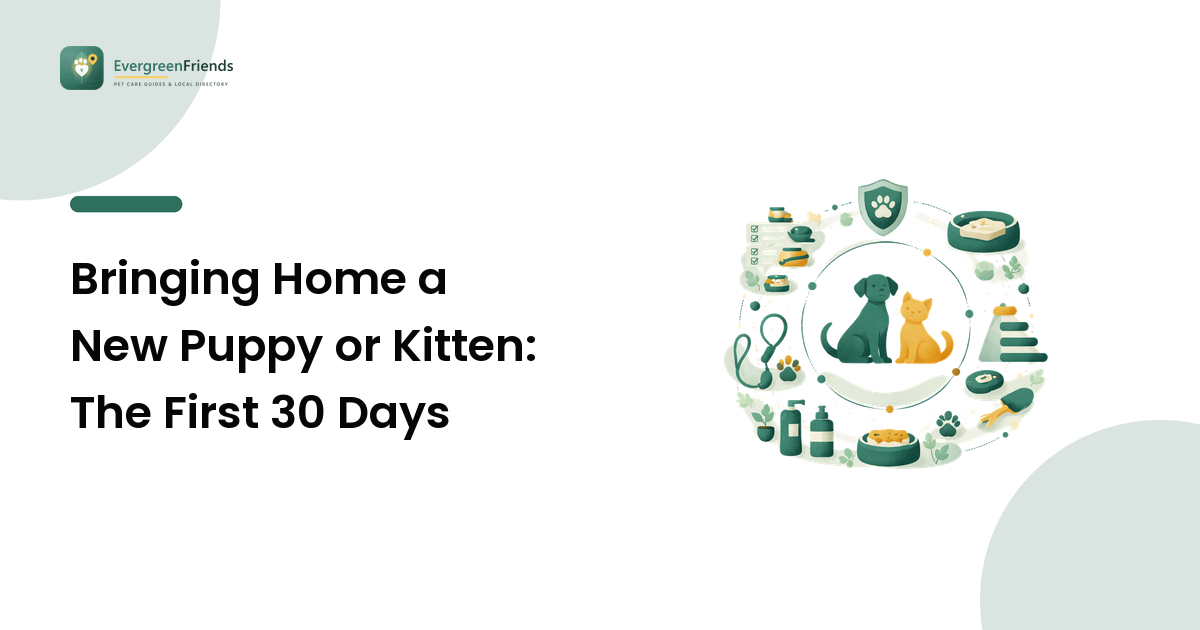
The first month with a new puppy or kitten is equal parts magic and mild chaos. There will be a moment — probably around 3 a.m. on night two — when you wonder what you've done. This is normal. Every good owner you know has stood in a kitchen at dawn holding a roll of paper towels, questioning their choices.
Here's the reassuring truth: the first 30 days follow a predictable arc, and if you prepare the home, protect the routine, and keep your expectations honest, you'll come out the other side with a settled pet and the foundations of a decade-plus friendship. This guide walks the whole arc — before arrival, day one, week one, and weeks two to four — for puppies and kittens alike, with the differences called out where they matter. (Still deciding which animal? Do that first — our guide to choosing a breed that fits your life is the step before this one.)
One framing note up front: this is general pet-care information, not veterinary advice. Your vet is a main character in this month — you'll see them below.
Before arrival: prepare the home, not just the shopping cart
The supplies checklist
Get these in place before the animal arrives — day one is not the day for a shop run.
For either species:
- Food and water bowls (a settled spot, away from foot traffic)
- The same food they've been eating — ask the shelter, fosterer, or breeder exactly what and how much. Week one is not the time to change diets; if you want to switch later, do it gradually over a week or so.
- A bed and a "safe zone" (crate for a puppy; a quiet room with hiding spots for a kitten)
- An ID tag and a plan for microchip registration (often already chipped — get the registration transferred to you)
- A few appropriate toys — chewable for puppies, chase-and-pounce for kittens
Puppy extras: collar and lead, poop bags, enzymatic cleaner (ordinary cleaners don't fully remove the smell that invites repeat accidents), training treats, and a crate sized so they can stand and turn around.
Kitten extras: litter box + the litter type they already know, a scratching post or tree, and a carrier that opens from the top or front (you'll thank yourself at the vet).
Pet-proof like a toddler is coming
Get on the floor — literally — and look at the room from their height. Cables tucked away or covered; medications, cleaning products, and rubbish bins behind doors; small swallowables off the floor; houseplants checked, because several common ones are toxic — lilies in particular are dangerous to cats and are safest kept out of the house entirely. For kittens, close off the gaps: behind appliances, under beds, inside reclining furniture. For puppies, decide now which rooms are off-limits and put the baby gates up before, not after, the first chewed shoe.
Set the human rules first
Agree as a household, before arrival: who feeds, who walks, what the pet's allowed on, and — critically — what words you'll use. If one person says "down" and another says "off," the puppy learns neither. Write the shared vocabulary on the fridge. It feels silly and it works.
Day one: less is more
The biggest day-one mistake is throwing a welcome party. To a puppy or kitten, your home is a strange planet full of new smells and giant strangers. What they need is calm.
- Puppies: go straight to the toilet spot outside before entering the house. If they go, praise warmly — house-training just started on a win.
- Kittens: carry them (in the carrier) to the prepared quiet room and open the door of the carrier — then let them come out at their own pace. Some explore in minutes; some stay hidden for a day. Both are normal.
- Show them water, food, and the sleeping spot. Then let them sniff, wander, and nap.
- Keep visitors to zero on day one, and let children interact gently, seated, and briefly.
Expect the first nights to be noisy. A puppy crying in the crate isn't manipulating you — it's a baby animal alone for the first time. Warm bedding, a ticking clock or heartbeat toy, and having the crate near your bed for the first nights all typically help. It usually settles within a week or two.
Week one: routine is the whole job
If you do only one thing this week, do this: the same things at the same times every day. Meals, toilet trips, play, sleep — predictability is how a young animal learns the world is safe.
The first vet visit — book it now. Within the first few days, take your new pet, their paperwork, and (for the full experience) a stool sample to your vet. This visit registers them at the clinic, checks them over, and sets your schedule for vaccinations, parasite prevention, microchip details, and the neutering conversation. Vaccination timing and products are the vet's call — your job is just to keep the appointments they set. Write down every question you've been googling and ask them instead; that's what the visit is for.
Puppy house-training, the short version: out after every sleep, meal, and play session, plus roughly every 1–2 hours at first; praise like they won a medal when they go outside; interrupt gently and take them out if caught mid-accident; and never punish an accident you find later — they cannot connect the two, and punishment only teaches them to hide it. Clean accidents with the enzymatic cleaner.
Kitten litter training is typically much easier — most kittens arrive knowing the job. Your part: keep the box clean (scooped daily), quiet, easy to reach, and away from the food. If a litter-trained kitten stops using the box, something's wrong — with the box, the location, or the kitten — and if it persists more than a day or two, ask your vet.
Sleep protection: puppies and kittens sleep enormous amounts — often most of the day — and they need it. Teach children that a sleeping pet is off-limits. An overtired puppy, like an overtired toddler, is a menace; many "crazy biting" evenings are actually nap deficits.
Weeks two to four: socialisation and first skills
With the home base settled, this is the month's real work — and for puppies it's time-sensitive.
Puppy socialisation means positive, gentle exposure to the ordinary world: different people, sounds, surfaces, traffic at a distance, car rides, being handled. Puppies pass through an early window (roughly the first few months of life) when they most easily accept new things, so this month counts double. Two rules keep it safe: pair every new thing with treats and calm, never force an interaction — and respect the vaccination boundaries your vet gives you about where the puppy can go and which dogs it can meet before its course is complete. Carried outings and visits from known, vaccinated dogs are the classic workarounds; your vet will tell you what's sensible for your area.
Kitten socialisation is quieter but real: gentle daily handling (paws, ears, mouth — future-you at nail-trim time says thanks), the carrier left out as a normal piece of furniture with treats inside, and short positive encounters with the household's people and any resident pets.
First skills. Keep training sessions to a few minutes, several times a day, always ending on a success. For puppies: their name, sit, coming when called, and walking on a loose lead around the house. For kittens: their name, coming for a treat sound, and scratching the post (put it next to the sofa corner they've chosen, not in a far room). Reward-based methods are the way — for both species, punishment mostly teaches fear, and a young animal learning that you're safe is worth more than any single command.
Introducing resident pets — slowly. Days of scent-swapping before any face-to-face; barriers (gate or cracked door) before shared rooms; every calm moment rewarded. Weeks, not days, is the normal timeline for a genuine pet-to-pet friendship, and rushing it is the most common way it goes wrong.
The normal wobbles — and the ones that aren't
Completely normal in month one: accidents after days of progress, a kitten hiding when guests arrive, crying at night early on, chewing and play-biting, an appetite that wobbles for a day as they settle, and a mid-month evening where you question everything. Progress with young animals is two steps forward, one step back — the trend matters, not the day.
Not "wait and see" — call your vet: refusing food for more than a day (sooner for very young or tiny animals — they have small reserves), repeated vomiting or diarrhoea, lethargy or hiding plus not eating, straining in the litter box, coughing, laboured breathing, or anything that simply feels wrong to you. New owners worry about being "that person" who calls the clinic too much. Vets universally prefer that person to the one who waited. The call is free; regret isn't.
FAQ
What do I need to buy before bringing a puppy or kitten home?
The essentials: bowls, the same food they're already eating, a bed plus a crate (puppy) or quiet safe room (kitten), collar/lead and poop bags for a puppy, litter box with their familiar litter and a scratching post for a kitten, a carrier, an ID tag, a few suitable toys, and enzymatic cleaner. Have it all in place before arrival day.
How long does it take a new puppy or kitten to settle in?
Most begin relaxing within a few days and feel genuinely at home somewhere between a few weeks and a few months — a common shorthand is three days to decompress, three weeks to learn the routine, three months to fully belong. Shy animals and rehomed adults can take longer. Consistent routine is the biggest accelerator.
When should a new pet first see the vet?
Within the first few days of arriving, even if they seem perfectly healthy. The first visit establishes a baseline, checks the microchip, and sets the vaccination, parasite-prevention, and neutering schedule — all of which are your vet's call, not the internet's. Bring any paperwork from the breeder, shelter, or fosterer.
Is it normal for a new kitten to hide, or a puppy to cry at night?
Yes — both are among the most normal things in this entire month. Give a hiding kitten time, food, and a quiet room and let it emerge at its own pace; comfort a crying puppy with warm bedding and the crate near your bed for the first nights. Both typically fade within a week or two. If hiding comes with not eating, or anything else seems off, ask your vet.
You've got this
The first 30 days are the steepest part of the whole journey — routine, patience, one good vet visit, and gentle early lessons carry you through it. For what comes next — feeding, grooming, training, and what's typical for your particular breed at every life stage — see the life-stage guides and full breed profiles on Evergreen Friends, and settle in for the good part.