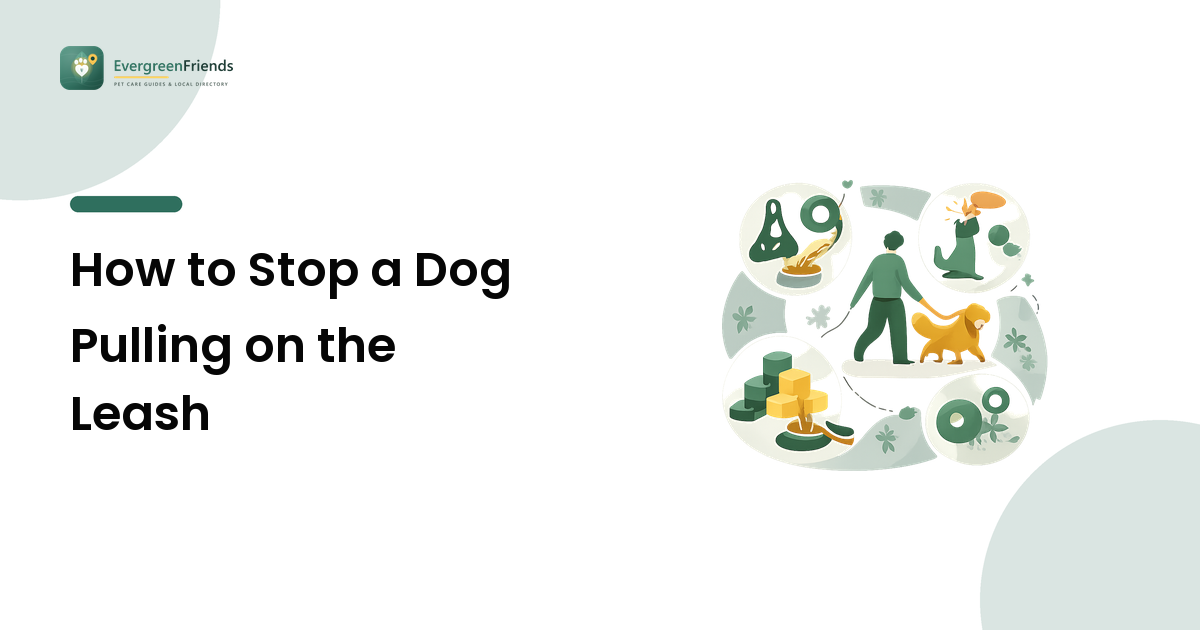
If your daily walk has turned into a tug-of-war — your dog out front like a sled team, you leaning back with a sore shoulder — you are not doing anything wrong, and neither is your dog. Pulling is one of the most common walking problems owners face, and the reason is refreshingly simple: pulling works. The dog wants to get to the lamppost, the pull moves them toward the lamppost, and every walk quietly rewards the behaviour you're trying to stop. The good news is that the same logic runs in reverse. Once pulling stops paying off and a loose lead starts to, most dogs change their minds surprisingly fast.
This guide walks through why dogs pull, the gear that genuinely helps (and the kind that doesn't), and a calm, step-by-step method you can start on your next walk. Quick note first: everything here is general pet-care and training information, not veterinary advice. A sudden change in how your dog moves, or pain when you touch the neck or shoulders, is a vet conversation, not a training one.
Why dogs pull in the first place
It helps to drop the idea that a pulling dog is being dominant or stubborn. Two plainer things are going on. First, dogs simply walk faster than we do, and the world is wildly more interesting to a nose than to a pair of human eyes — there is enormous motivation to get to the next smell. Second, and more importantly, we accidentally train the pull. When a dog surges ahead and we follow, the lead tightening becomes the cue that says "keep going." Over hundreds of walks, that lesson sinks in deep.
There's also a reflex at play: dogs naturally push against steady pressure rather than yielding to it, so hauling back on a taut lead often makes a dog dig in harder, not softer. That single fact explains why so much of what feels intuitive — bracing and pulling back — makes pulling worse. The method below works with that reflex instead of against it.
Get the gear right before you retrain
You cannot fix pulling with equipment alone, but the right kit makes the training far easier and keeps your dog comfortable while they learn.
- A well-fitted harness. A front-clip or Y-shaped harness that attaches at the chest is the kindest starting point for a puller. It spreads pressure across the body instead of the throat, and a front attachment gently turns the dog back toward you when they surge, rather than letting them lean into a neck collar.
- A standard fixed-length lead, about 1.5 to 2 metres. Long enough for a little freedom, short enough to stay connected. Skip the retractable lead for this work — it teaches a dog that a tight lead extends the world, which is the exact opposite of the lesson.
- What to avoid. Choke, prong, and slip collars stop pulling by causing discomfort or pain, and they carry a real risk of injuring the neck and windpipe. They also do nothing to teach the dog what you want — they only punish what you don't. A body harness plus a bit of patience gets you a dog that chooses to walk nicely, which is a sturdier result.
Fit matters: on a harness you should be able to slide two fingers under the straps, with no rubbing at the armpits. If you're still assembling your walking kit, sensible lead and harness choices are part of the wider everyday dog care routine.
The core method: pulling never works, slack always pays
The whole technique rests on one rule your dog will figure out quickly: a tight lead makes the walk stop; a loose lead makes the walk continue. You are going to make forward motion — the thing your dog wants most — depend entirely on the lead staying slack.
There are two complementary versions. Most people use both.
The "stop like a tree" version
- Start walking. The moment the lead goes tight, stop dead and stand still. No yanking, no telling off — just become a boring, immovable tree.
- Wait. Your dog will eventually ease the tension — glancing back, stepping toward you, or sitting. The instant the lead softens, say a warm marker word ("yes!") and walk on again. Walking on is the reward.
- Repeat every single time the lead tightens. Yes, your first few "walks" may cover twenty metres in ten minutes. That's normal, and it's the point: your dog is learning that pulling gets them nowhere and slack gets them everywhere.
The "change direction" version
If standing still isn't landing, add movement. The moment the lead tightens, turn and walk calmly the other way, so your dog has to catch up and reorient to you. Done gently, this teaches your dog to keep half an eye on where you are going instead of towing you toward wherever they please. Alternate direction changes with tree-stops and you'll cover both bases.
Reward the position you actually want
Stopping the pull is only half the job — you also have to make the good position rewarding. Whenever your dog is walking with a loose lead near your side, mark it ("yes!") and hand over a small treat down by your leg, roughly where you want their head to be. You're paying for slack. Early on, pay generously and often; as it becomes a habit, thin the treats out and let the walk itself do more of the rewarding. Counting these treats into the day's food keeps waistlines honest.
Set the walk up to succeed
Training a pull out of a dog goes far faster when the walk isn't overwhelming to begin with.
- Drain some energy first. A dog that's been cooped up all day will be too wired to think. A few minutes of fetch or a sniffy potter in the garden before a training walk takes the edge off.
- Start somewhere boring. Practise loose-lead walking in the quiet of your hallway or a calm street before taking it to the thrilling chaos of the park. Skills learned in easy places transfer to hard ones — not the reverse.
- Keep sessions short. Five to ten focused minutes beats a frustrating hour. End while you're both still enjoying it.
- Let the nose have its turn. Build in stretches where sniffing is allowed on a loose lead. A sniffy walk is genuinely tiring and deeply satisfying for a dog, and it takes the desperation out of the pulling. Some owners use a release word like "go sniff" so the dog learns there's a time for exploring and a time for walking with you.
Common mistakes that keep the pulling alive
A few habits quietly undo all the good work:
- Inconsistency. If pulling is stopped on the training walk but tolerated on the rushed morning wee-break, the dog learns that pulling sometimes works — and "sometimes" is enough to keep any behaviour going. Everyone who walks the dog needs to play by the same rule.
- Reeling the dog in. Cranking a tight lead shorter gives your dog something to brace against and rewards the very tension you want gone. Keep your lead hand soft and let stopping, not hauling, do the work.
- Expecting it overnight. Loose-lead walking is a skill built over weeks, not a switch you flip. Some breeds — the strong, driven, working and scent types — take longer and need more practice. That's typical, not failure.
- Punishing the pull. Jerking the lead or scolding adds stress and can make a dog associate the walk (and you) with something unpleasant. Calm and repetitive beats harsh every time.
FAQ
How long does it take to stop a dog pulling on the leash?
It varies with the dog, their age, how long pulling has been rehearsed, and how consistent everyone is. Many owners see clear improvement within a couple of weeks of daily practice, but a reliable loose lead in exciting places usually takes a month or more. Strong, high-drive breeds and dogs with a long pulling history typically need longer — steady daily reps matter far more than any single long session.
Do anti-pull harnesses actually work?
A well-fitted front-clip or Y-shaped harness makes pulling less rewarding and far more comfortable for the dog, which buys you the space to train. But no harness teaches loose-lead walking on its own — pair the gear with the stop-and-reward method or the dog will simply learn to pull in the harness. Avoid any device that works by causing pain or restricting breathing.
Why does my dog pull more when we get near the park?
Because that's where the best stuff is, and excitement overrides everything they know. Proximity to a thrilling destination is the hardest test of loose-lead walking, so treat it as advanced practice: slow right down, use plenty of tree-stops and direction changes, and reward heavily for any slack. If it falls apart completely, back up to a calmer spot and rebuild.
Should I use a retractable lead?
Not for fixing pulling. A retractable lead keeps a light tension on the line and extends whenever the dog moves forward, which teaches exactly the lesson you're trying to unteach — that a taut lead earns more freedom. Use a fixed lead of around 1.5 to 2 metres for training, and save any long-line freedom for safe, open spaces.
Is my dog pulling because they're trying to be dominant?
No. Pulling isn't a bid for status — it's the simple result of dogs walking faster than us toward things they find interesting, combined with a natural reflex to push against pressure and a history of pulling paying off. Framing it as behaviour that's been accidentally rewarded, rather than defiance, points you straight at the fix.
Keep walks calm, keep them consistent
Stopping a dog pulling on the leash comes down to one steady idea kept up over weeks: a tight lead stops the walk, a loose lead keeps it going, and the position you want gets paid. Skip the gear that hurts, set walks up so your dog can succeed, and let everyone in the house play by the same rule. For more calm, welfare-first routines and honest breed guidance — including which breeds typically need the most walking — see the everyday-care guides and breed profiles on Evergreen Friends.